
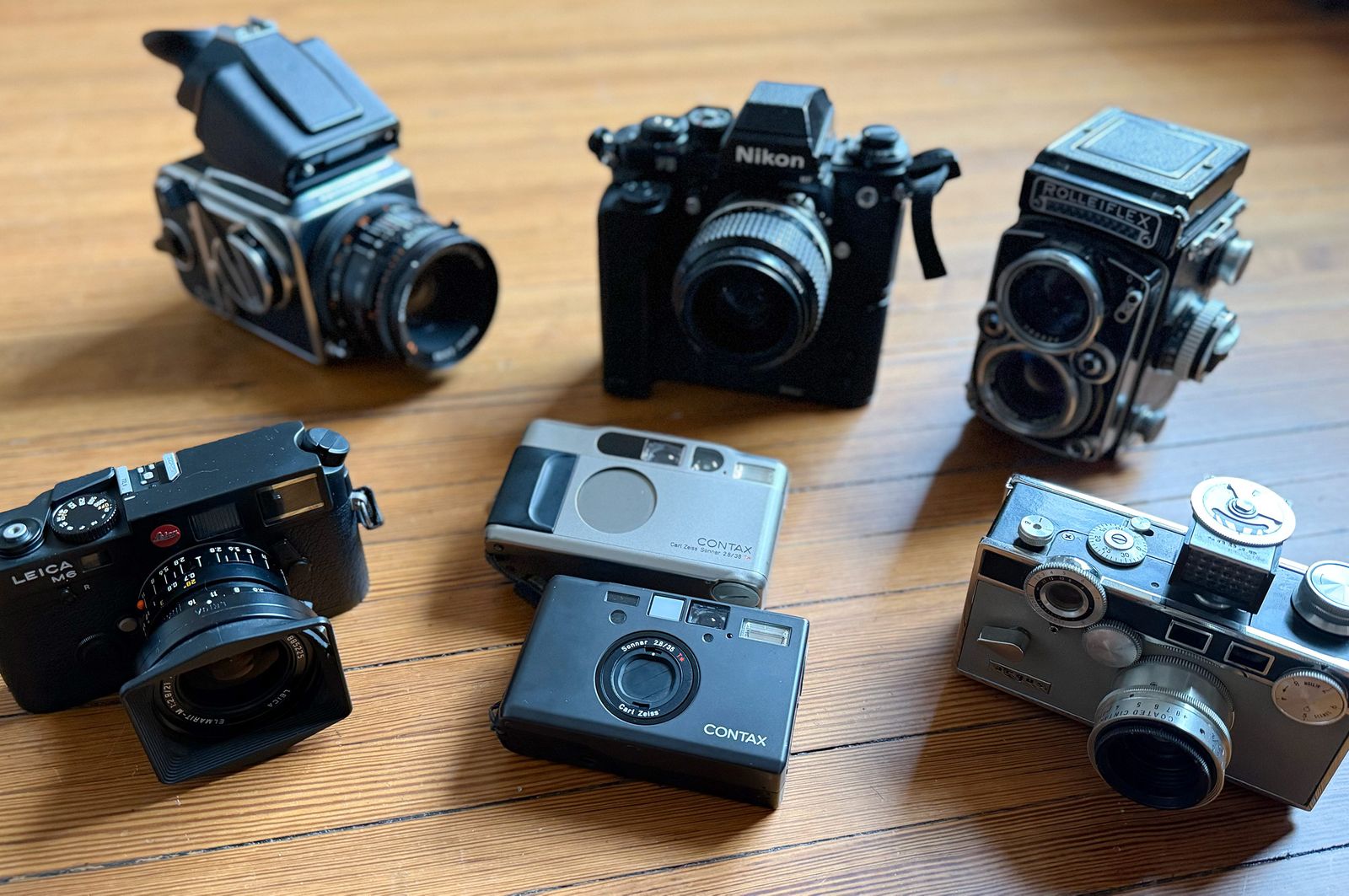
I love my old film cameras. There is something about these elegant mechanical objects that feel in my hands like familiar and practical tools. Hasselblad, Rolleiflex, Pentax, Contax, Leica, and Fujica cameras, all prompt muscle memory as I remember the way that they feel and sound, appreciating authentic clicks and clunks when the shutter button is pressed.
But as someone who grew up in the analog era, processing my own black and white film and making prints in the darkroom, I admit I won’t ever trade in my current soul-less but very efficient digital cameras for rolls of film.
When digital cameras first appeared more than two decades ago I was very skeptical that any digital solution could ever surpass the beauty and sharpness of film. Then I started using a Nikon D1X and learned that by shooting in a RAW file format, I could finesse the final image in the same way that I could with a black & white negative in the darkroom. That sense of control and precision that I could deliver in the darkroom was all of a sudden available to me in the world of color photography. I improved my Photoshop skills and could correct (or at least mitigate) all my in-camera mistakes and sloppiness. I was never an overly technical color photographer but could usually get close to the results I wanted on film through intuition and experience. But gradually, in the new world of digital photography, I achieved a measure of control and satisfaction that I had previously only experienced with black & white film and prints.
I remember the first digitally-captured overseas work trip, returning without my usual rolls of film stuffed into protective anti-x-ray bags and feeling very uncertain that the CF cards somehow contained the digital equivalent captured on film during previous trips. But of course I soon realized that the rhythm of shooting digitally, with the ability to quickly capture endless variations, and judge, amend and improve the picture as it happens, offered more certainty in the final result, rather than less.
Lost in the transition from film to digital was my ability to magically know that I had adequately captured “the shot,” and when it was time to move onto the next scheduled picture for the day or wrap it up and head home. Sometimes the decision was made for me because the light was fading or the person being photographed was running out of time. Sometimes I was down to my last roll of film.
Shooting with digital cameras forced a different rhythm of shooting, ultimately offering a path toward technically better pictures, but possibly giving up the occasional magic of happy photographic surprises. Regardless of results, I still miss the old cameras.